Configuration
Configuration is read from environment variables. Start from .env.example:
cp .env.example .env
Every variable shipped in .env.example is documented on this page, grouped
the same way as the file. Defaults shown are the values in .env.example;
"unset" means the variable is empty by default and the related feature stays
off until you fill it in.
Required for Real Deployments
Change these before exposing Manor AI beyond local evaluation:
| Variable | Purpose |
|---|---|
JWT_SECRET_KEY | Signs user sessions. Use a long random value. |
DATABASE_URL | Async PostgreSQL connection string. |
DATABASE_URL_SYNC | Sync PostgreSQL URL used by Alembic. |
REDIS_URL | Redis cache and broker URL. |
MINIO_ACCESS_KEY / MINIO_SECRET_KEY | Object storage credentials. |
PUBLIC_BASE_URL | Public URL used by webhooks and generated media callbacks. |
APP_URL | Browser-facing web URL. |
Deployment Mode and Model Defaults
| Variable | Default | Notes |
|---|---|---|
DEPLOYMENT_MODE | oss | oss is self-hosted mode. Leave it as oss for every self-hosted deployment. |
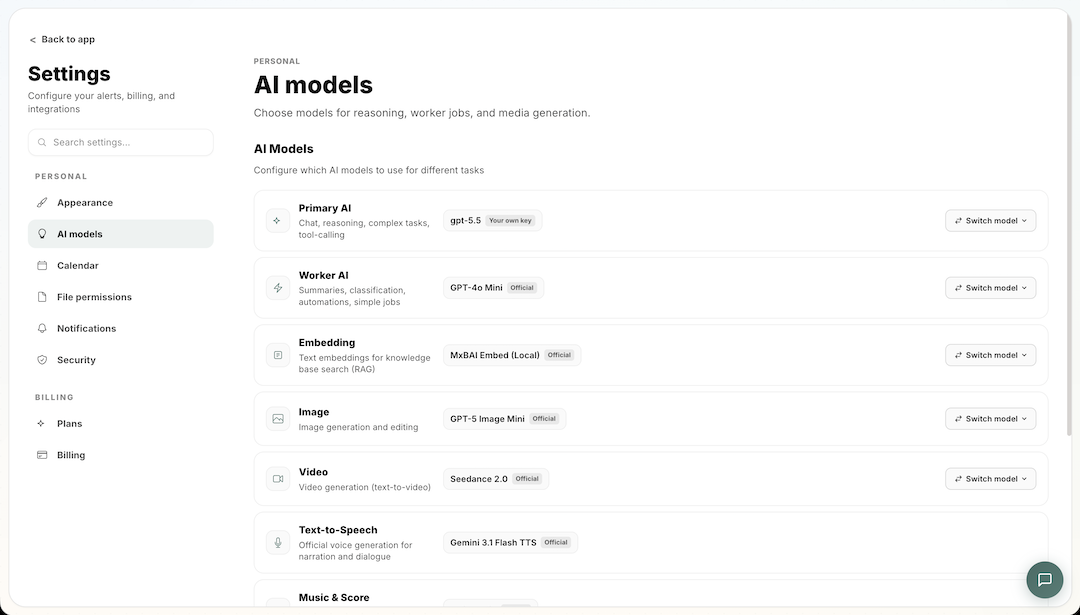
LLM_MODEL | anthropic/claude-sonnet-4 | Default model id. Users and entities can override it in Settings. |
Self-hosted Manor AI is BYOK (bring your own key): model calls only run with provider credentials configured in Settings. Avoid baking model API keys into images or source control.
Database
| Variable | Default | Notes |
|---|---|---|
DATABASE_URL | postgresql+asyncpg://manor:manor_secret@postgres:5432/manor | Async SQLAlchemy URL used by the API and worker. |
DATABASE_URL_SYNC | postgresql://manor:manor_secret@postgres:5432/manor | Sync URL used by Alembic migrations. Keep it pointing at the same database as DATABASE_URL. |
DATABASE_POOL_SIZE | 5 | Connections held open per API process. |
DATABASE_MAX_OVERFLOW | 2 | Extra connections allowed above the pool size under burst load. |
DATABASE_POOL_TIMEOUT | 10 | Seconds to wait for a free connection before failing. |
DATABASE_POOL_RECYCLE | 1800 | Seconds before a pooled connection is recycled. |
The pool defaults are sized for a single-host deployment. If you raise
API_WORKERS, remember each worker process opens its own pool:
total connections ≈ API_WORKERS × (DATABASE_POOL_SIZE + DATABASE_MAX_OVERFLOW)
plus the Celery worker. Keep that sum below your PostgreSQL max_connections.
Redis
| Variable | Default | Notes |
|---|---|---|
REDIS_URL | redis://redis:6379/0 | Cache, Celery broker, rate-limit backend, and presence store. |
REDIS_MAXMEMORY | 0 | Memory cap for the Redis service. 0 means unlimited. For shared hosts a bounded value such as 512mb is safer. |
REDIS_MAXMEMORY_POLICY | noeviction | Eviction policy once the cap is hit. Pair a bounded REDIS_MAXMEMORY with allkeys-lru if you can tolerate cache eviction. |
Database /1 on the same Redis instance is used by JuiceFS metadata (see
Storage); keep /0 and /1 distinct
if you point Manor at an external Redis.
API Server Tuning
Single-server emergency controls. The defaults are conservative and safe for evaluation; measure CPU, p95 latency, and DB connections before raising them.
| Variable | Default | Notes |
|---|---|---|
API_WORKERS | 1 | Uvicorn worker processes. |
API_LIMIT_CONCURRENCY | 120 | Maximum concurrent connections per worker before requests are rejected. |
API_BACKLOG | 256 | Socket backlog for pending connections. |
API_TIMEOUT_KEEP_ALIVE | 5 | Keep-alive timeout in seconds. |
Rate Limits
All limiters are opt-in and disabled by default for local evaluation. Enable them on any deployment shared with real users.
| Variable | Default | Notes |
|---|---|---|
RATE_LIMIT_ENABLED | false | Master switch for the general API limiter. |
API_RATE_LIMIT_REQUESTS | 200 | Requests allowed per window per client. |
API_RATE_LIMIT_WINDOW_SECONDS | 60 | Window length for the general limiter. |
CHAT_RATE_LIMIT_ENABLED | false | Separate limiter for chat routes, which are the most expensive. |
CHAT_RATE_LIMIT_REQUESTS | 30 | Chat requests allowed per window. |
CHAT_RATE_LIMIT_WINDOW_SECONDS | 60 | Window length for the chat limiter. |
REDIS_RATE_LIMIT_ENABLED | false | Store limiter state in Redis so limits are shared across all API workers instead of per-process. Enable whenever API_WORKERS > 1. |
Degraded Mode
Emergency brake for overloaded deployments. When DEGRADED_MODE=true,
high-cost routes return 503 with code=degraded_mode while health checks,
config, login, and basic reads keep working.
| Variable | Default | Notes |
|---|---|---|
DEGRADED_MODE | false | Master switch. |
DEGRADED_DISABLE_CHAT_STREAM | true | While degraded, disable streaming chat. |
DEGRADED_DISABLE_SANDBOX | true | While degraded, disable sandbox execution. |
DEGRADED_DISABLE_MEDIA_GENERATION | true | While degraded, disable image/video generation. |
DEGRADED_DISABLE_LARGE_UPLOADS | true | While degraded, reject large uploads. |
The four DEGRADED_DISABLE_* switches only take effect while
DEGRADED_MODE=true; they let you choose which capabilities the brake covers.
Object Storage and Entity Filesystem
Manor AI uses MinIO for object storage and JuiceFS for entity-scoped
filesystem storage. The default Compose stack formats and mounts the JuiceFS
volume automatically via the juicefs-init service.
| Variable | Default | Notes |
|---|---|---|
MINIO_ENDPOINT | minio:9000 | S3-compatible endpoint. |
MINIO_ACCESS_KEY | minioadmin | Change for any shared deployment. |
MINIO_SECRET_KEY | minioadmin | Change for any shared deployment. |
MINIO_BUCKET | manor | Bucket for uploads and generated artifacts. |
MANOR_FS_ENABLED | true | Enables the per-entity filesystem (agent file tools, knowledge file sync). |
MANOR_FS_ROOT | /mnt/manor | Mount path used by the API and workers. |
JUICEFS_META_URL | redis://redis:6379/1 | JuiceFS metadata store. Uses Redis database /1. |
JUICEFS_STORAGE | minio | JuiceFS data backend type. |
JUICEFS_BUCKET | http://minio:9000/manor | Object store bucket URL for JuiceFS data blocks. |
JUICEFS_ACCESS_KEY | minioadmin | Keep in sync with the MinIO credentials. |
JUICEFS_SECRET_KEY | minioadmin | Keep in sync with the MinIO credentials. |
Sandbox
| Variable | Default | Notes |
|---|---|---|
SANDBOX_SERVICE_URL | http://sandbox:8000 | URL of the isolated code-execution service. |
SHELL_SANDBOX_ENABLED | true | Allows agents to run shell commands inside the sandbox service. Set false to disable shell execution entirely. |
See Sandbox operations for what runs inside the boundary.
Authentication
| Variable | Default | Notes |
|---|---|---|
JWT_SECRET_KEY | change-this-to-a-random-string | Must be replaced before any shared deployment. |
JWT_ALGORITHM | HS256 | Token signing algorithm. |
JWT_EXPIRE_MINUTES | 1440 | Session lifetime (24 hours by default). |
GOOGLE_CLIENT_ID / GOOGLE_CLIENT_SECRET | unset | Enables "Sign in with Google". Create a Web OAuth client in Google Cloud Console. |
VITE_GOOGLE_CLIENT_ID / VITE_GOOGLE_DRIVE_API_KEY | unset | Enables the Google Drive Picker on the Knowledge page. Requires the Google Picker API and Google Drive API enabled in your Google Cloud project. |
Email (SMTP)
Outbound email powers invites, verification codes, notifications, and email-channel replies.
| Variable | Default | Notes |
|---|---|---|
EMAIL_ENABLED | false | Master switch. Leave off if you have no SMTP server; flows that would email fall back silently. |
SMTP_HOST | unset | SMTP server hostname. |
SMTP_PORT | 587 | Standard STARTTLS port. |
SMTP_USER / SMTP_PASSWORD | unset | SMTP credentials. |
SMTP_FROM_EMAIL / SMTP_FROM_NAME | unset | From-address and display name on outbound mail. |
SMTP_STARTTLS | true | Upgrade the connection with STARTTLS. |
Secrets Encryption (Vault)
Integration credentials and other secrets are encrypted at rest through a
Vault transit backend. The Compose stack ships a local vault helper service
for development-style deployments.
| Variable | Default | Notes |
|---|---|---|
VAULT_TOKEN | unset | Token for the Vault transit backend. |
VAULT_TRANSIT_KEY | manor-keys | Name of the transit key used for encrypt/decrypt. |
Agent Tools: Search and Market Data
| Variable | Default | Notes |
|---|---|---|
SEARCH_ENGINE | serper | Web-search backend for the agent search tool: serper or tavily. |
SEARCH_API_KEY | unset | API key for the chosen search engine. Without it the web-search tool is unavailable. |
FINNHUB_API_KEY | unset | Enables live market data in generated Dashboard modules. |
Public URLs
| Variable | Default | Notes |
|---|---|---|
PUBLIC_BASE_URL | http://localhost:8010 | Base URL external providers can reach this deployment at. Used to build webhook and OAuth callback URLs, and to sign public file URLs (/api/v1/fs/public/{token}) that media providers fetch for image-to-video generation. Must be https:// in production. |
APP_URL | http://localhost:18080 | Browser-facing web URL. The default Compose web service listens on 18080 and proxies /api to the API container. |
For local webhook testing, use a trusted HTTPS tunnel and set
PUBLIC_BASE_URL to the tunnel URL while it is active.
Feature Rollout
| Variable | Default | Notes |
|---|---|---|
FLOWS_AVAILABLE | unset | Workflow launch gate. Local and development environments enable Flows by default; when MANOR_ENV is prod/production the navigation entry shows as Soon until this is true. |
MANOR_PREVIEW_INTEGRATIONS | unset | Comma-separated provider keys to surface "Coming Soon" integrations (for example facebook,gmail) on non-production deployments for test-user work. |
MANOR_PREVIEW_CHANNELS | unset | Same as above for message channels. |
MANOR_ENV itself defaults to local when DEPLOYMENT_MODE=oss, so a stock
self-hosted install has Flows enabled without extra configuration.
Channel Integrations
Each provider needs an OAuth app registered at that provider's developer
portal, with the callback URL set to
{PUBLIC_BASE_URL}/api/v1/integrations/oauth/{server_key}/callback.
| Variable | Notes |
|---|---|
TELEGRAM_MODE | Inbound mode: webhook (needs HTTPS; registered when the integration is saved), polling (async getUpdates loop, no public URL needed), or auto (default — webhook when PUBLIC_BASE_URL is https, else polling). |
GITHUB_CLIENT_ID / GITHUB_CLIENT_SECRET | GitHub OAuth app. |
LINKEDIN_CLIENT_ID / LINKEDIN_CLIENT_SECRET | LinkedIn OAuth app. |
X_CLIENT_ID / X_CLIENT_SECRET | X (Twitter) OAuth app. |
SLACK_CLIENT_ID / SLACK_CLIENT_SECRET | Slack OAuth app. |
NOTION_CLIENT_ID / NOTION_CLIENT_SECRET | Notion OAuth app. |
QUICKBOOKS_CLIENT_ID / QUICKBOOKS_CLIENT_SECRET | QuickBooks OAuth app. |
MS_CLIENT_ID / MS_CLIENT_SECRET | One Azure AD app registration powers Outlook, OneDrive, Microsoft Calendar, Teams, and Excel. Set the redirect URI to the callback URL above; the required delegated Microsoft Graph permissions are listed in .env.example. |
MS_TENANT | common (work/school + personal accounts), organizations, consumers, or a specific Azure AD tenant GUID. |
DISCORD_CLIENT_ID / DISCORD_CLIENT_SECRET | Discord OAuth client. |
DISCORD_PUBLIC_KEY | Ed25519 public key (hex) used to verify interaction signatures. |
DISCORD_BOT_TOKEN | Required if the bot sends messages. |
TWILIO_ACCOUNT_SID / TWILIO_AUTH_TOKEN | SMS, Voice, and WhatsApp via Twilio. |
DEEPGRAM_API_KEY | Streaming speech-to-text for Twilio Media Streams voice calls. |
OPENAI_API_KEY | Text-to-speech for voice calls, reused by /audio/speech. |
Nango (SaaS OAuth Aggregator)
Nango unlocks OAuth connections to 200+ SaaS platforms. Start the bundled server with:
docker compose --profile nango up -d nango-server
Then open http://localhost:3003, set the admin password, and copy the
Secret Key into NANGO_SECRET_KEY.
| Variable | Default | Notes |
|---|---|---|
NANGO_BASE_URL | http://nango-server:3003 | Internal URL of the Nango server. |
NANGO_PUBLIC_URL | unset | Public hostname for OAuth callbacks and SaaS webhooks. Local dev can leave it empty; production should use https://nango.<your-domain> behind your reverse proxy. |
NANGO_SECRET_KEY | unset | From the Nango admin UI. Leave empty to disable Nango entirely. |
NANGO_PUBLIC_KEY | unset | Public key from the Nango admin UI. |
NANGO_WEBHOOK_SECRET | unset | Any random 32+ character string. Manor's startup hook writes the same value into Nango so its outbound webhooks are signed; verified on receive at /api/v1/nango/webhook. |
NANGO_WEBHOOK_URL | unset | URL Nango POSTs webhooks to. Defaults to the Compose-internal http://api:8000/api/v1/nango/webhook; override for production. |
Per-platform provider bootstrap
For every Nango-aggregated platform you want available, add a pair of variables and Manor pushes them into Nango's admin database on API startup — no clicking through the Nango admin UI:
NANGO_PROVIDER_<PROVIDER>_CLIENT_ID=...
NANGO_PROVIDER_<PROVIDER>_CLIENT_SECRET=...
NANGO_PROVIDER_<PROVIDER>_SCOPES=...      # optional, space-separated
NANGO_PROVIDER_<PROVIDER>_KEY=...         # optional, defaults to <PROVIDER>
NANGO_PROVIDER_<PROVIDER>_PROVIDER=...    # optional, defaults to <PROVIDER>
The redirect URI to register at each platform's developer portal is
${NANGO_PUBLIC_URL}/oauth/callback. .env.example includes worked examples
for HubSpot and Facebook/Instagram, plus pointers to each platform's developer
console.
See Nango integration for when to use Nango versus a first-party OAuth app.